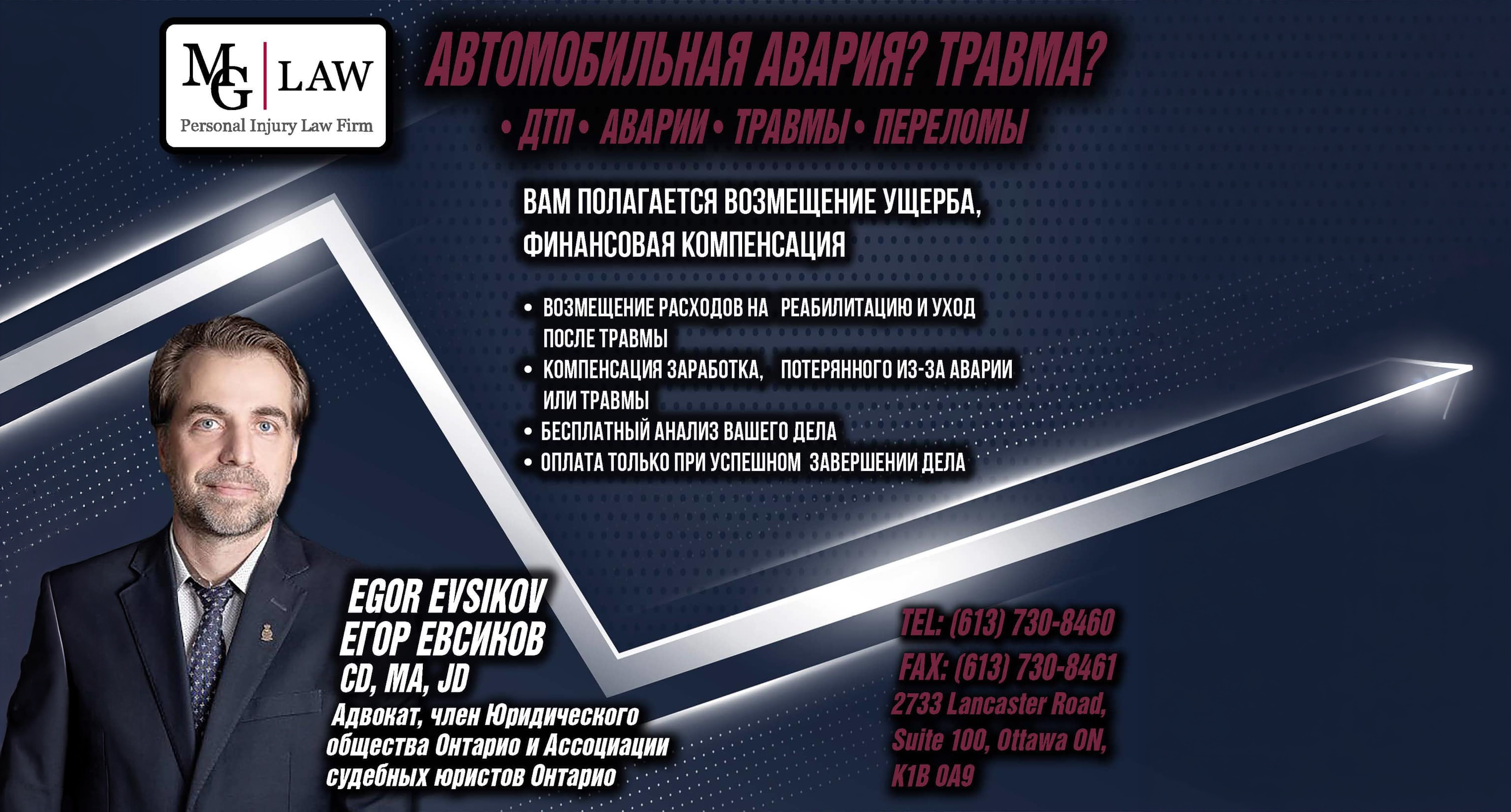

Accident? Injury? — We Can Help!
(An interview with lawyer Egor Evsikov - translated from Russian)
Nasha Ottawa Correspondent: Hello, dear readers! Today our guest is Egor Evsikov, a personal injury lawyer — an attorney who helps people obtain compensation if they were injured in a car accident, suffered a fall, or were harmed due to someone else’s negligence. This is truly an important topic: life is unpredictable, and in the moment of an accident or injury, a person is often in shock and does not understand where to go or what to do. Mistakes made in the first few days can cost money and even deprive someone of the opportunity to receive compensation.
Egor Evsikov: I completely agree: when a person is injured, they think first and foremost about pain, fear, and treatment — and that is normal. But at the same time, it is important to properly document the circumstances and take the necessary steps in time to protect one’s rights.
Correspondent: Many people know you as a chess coach for children. But your main profession is personal injury law. How does “chess thinking” help you win complex cases?
Egor: I would put it this way: in chess, it is important to see the situation several moves ahead, keep a cool head, and avoid panic. Legal practice works in almost the same way. You need to build the process strategically: gather documents, evidence, medical records, and think through how the opposing side — whether it is an insurance company or another party — will act. And very importantly, you must act calmly and move consistently toward the client’s goal.
Correspondent: Please tell us about yourself and your firm. How did you come to law?
Egor: I served in the Canadian Armed Forces for quite a long time and worked as an analyst, including in military intelligence and at headquarters. Over time, I decided to change my professional focus and went to study law at the University of Ottawa. Now I practice as a lawyer and specialize in personal injury cases: motor vehicle accidents, slips and falls, and injuries resulting from various incidents.
Our firm, MG Law, has been operating in Ottawa since 2009. It was founded by Miryam Gorelashvili. At MG Law, we have around 20 staff members and several lawyers who specialize specifically in personal injury — motor vehicle accidents, slips and falls, medical negligence, and related matters. We are a legal practice focused specifically on personal injury. Our goal is to support the client from the first call through to the result. We help organize the legal side of the process: communicating with insurance companies, gathering and preparing documents, requesting medical records, preparing evidence, negotiating, and, when necessary, litigation. We try to take on all the heavy legal work so that the person can focus on recovery.
Correspondent: Would it be fair to say that your military analytical experience helped you better understand injuries — after all, people in the military often get hurt during training or service. Does that influence your approach?
Egor: Yes, absolutely. Military service and analytical work taught me to work with facts, see cause-and-effect relationships, and approach complex situations systematically. And just as importantly, I saw how injuries — both physical and psychological — change people’s lives. That is why, in our work, it is important to me not only to “handle a case,” but to support the client: to help them through the rehabilitation process and obtain fair compensation.
Correspondent: Let us imagine a situation: a person is in a car accident, slips in a parking lot, falls in a store, or is struck and injured. They still do not understand whether it is serious — “just a bruise” or an injury with consequences. What should they do right away so they do not lose the chance to receive compensation?
Egor: The very first thing is medical care. If the condition is serious, call an ambulance. Even if it seems “not too bad,” you should see a doctor as soon as possible and describe your symptoms in detail. An important point: the consequences of a concussion, neck injuries, and back injuries often do not appear immediately. A person may be in shock, and only a few days later develop headaches, dizziness, sleep problems, and other symptoms.
Second, document the circumstances. If possible, take photos of the location, the cause of the fall (ice, wet floor, obstacle), injuries, shoes, clothing, and any visible traces. If it is a motor vehicle accident, document the cars, licence plates, wide shots, and road conditions. If you fell indoors, notify staff and ask that the incident be recorded within the organization.
Third, notice requirements and deadlines. In some situations, time limits can be very short. For example, if the injury occurred on municipal property, in some cases the municipality must be notified quickly. In motor vehicle accidents, it is important to contact the insurance company as soon as possible. And fourth, contact a lawyer so you do not miss important steps.
Correspondent: There is a common belief that lawyers are very expensive, and people are afraid to consult one even if they feel they may be entitled to compensation. What would you say to readers who are worried about cost?
Egor: In the personal injury field, the contingency fee model is common — that is, payment based on the result. Simply put, the client usually does not pay us in advance, and the legal fee is paid as a percentage of the compensation — if compensation is obtained, whether through court or settlement. If there is no compensation, as a rule, the client does not pay legal fees.
In addition, our first consultation is free: a person can come in, explain what happened, and receive an honest assessment of the situation — what to do next, what documents are needed, and what the prospects are.
Correspondent: Another important advantage, especially for Russian-speaking readers, is language. Even if a person knows English, legal and medical terminology is a world of its own. In what languages can you communicate with clients?
Egor: At our firm, it so happens that staff members speak many languages. We have specialists who know Russian, Ukrainian, French, and other languages. This truly makes life easier for the client: it is easier for a person to describe symptoms, circumstances, and emotions accurately in their native language — especially in a stressful situation.
Correspondent: In Canada, many people have insurance, especially car insurance. It seems logical: if you are in an accident, go to the insurance company and everything will be resolved. In what situations should people contact you, and when is the insurance company enough?
Egor: If only the car is damaged and there are no injuries, insurance is often enough: they handle the repair or the payout. But if there is an injury, especially a serious one, I would recommend consulting a lawyer. Injury cases involve many nuances: medical consequences, long-term limitations, rehabilitation, lost income, and family expenses.
And one more important point: the interests of the insurance company and the injured person do not always align. An insurance company is a business that seeks to minimize payouts. Our job is to make sure the client receives the maximum fair compensation possible and access to rehabilitation.
Correspondent: One final practical question. After an accident, a person is in shock: they do not remember phone numbers or names and may not even be able to explain clearly what happened. How can they make it easier to access your help in advance?
Egor: The simplest advice is to save my contact in your phone in advance. You can also cut out my business card from the back cover of the magazine and keep it next to your insurance papers or documents in the car. In the right moment, this really helps: you open your insurance papers and immediately know whom to call. And I will repeat: our initial consultation is free, so you can ask questions and get advice on what to do next.
Correspondent: Egor, thank you for the conversation and for the practical advice. Friends, take care of yourselves on the roads and on slippery streets. And most importantly, do not face the problem alone: if you have been injured and do not know what to do next, it is better to consult a specialist in time.
Egor: Thank you very much! I was glad to answer the questions, and I hope this information will help people avoid feeling lost in a difficult situation.
The video recording of the interview can be viewed on the Nasha Ottawa website: https://youtu.be/c2UgrjFNVCA