

Behind the mask
An interview with Larisa Sokolovska, Ph.D., professor and certified profiler
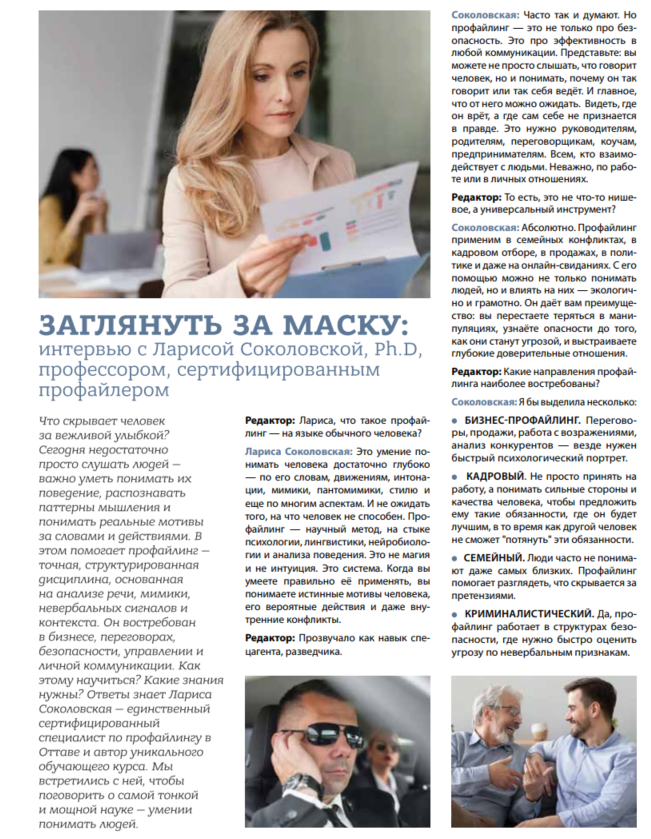
What does a person hide behind a polite smile? Today, simply listening to people is not enough. We need to understand their behaviour, recognize patterns of thought, and grasp the motives behind their words and actions. Profiling can help. It is a structured discipline based on the analysis of speech, facial expressions, nonverbal signals, and context. It is used in business, negotiations, security, management, and personal communication. How can you learn it? What knowledge do you need? Larisa Sokolovska, Ottawa’s only certified profiling specialist and the creator of a distinctive training course, has the answers. We met with her to talk about the subtle and powerful skill of understanding people.
Editor: Larisa, what is profiling in everyday terms?
Larisa Sokolovska: It is the ability to understand a person deeply enough through their words, movements, tone of voice, facial expressions, body language, style, and many other details. It also means not expecting someone to do what they are incapable of doing. Profiling is a scientific method at the intersection of psychology, linguistics, neuroscience, and behavioural analysis. It is not magic or intuition. It is a system. When you know how to use it properly, you can understand a person’s underlying motives, likely actions, and even inner conflicts.
Editor: That sounds like a skill for an intelligence agent.
Sokolovska: People often think so. But profiling is about more than security. It can make any form of communication more effective. Imagine being able not only to hear what someone says, but also to understand why they say it or behave as they do. Most importantly, you can better understand what to expect from them. You may recognize when someone is lying and when they cannot admit the truth even to themselves. Managers, parents, negotiators, coaches, and entrepreneurs can all use this skill—anyone who interacts with people, at work or in personal relationships.
Editor: So it is a general-purpose tool, not a niche skill?
Sokolovska: Absolutely. Profiling can be applied to family conflicts, hiring, sales, politics, and even online dating. It can help you understand people and influence them thoughtfully and responsibly. It gives you an advantage: you are less likely to be thrown off by manipulation, you can recognize warning signs early, and you can build relationships rooted in trust.
Editor: Which areas of profiling are most in demand?
Sokolovska: I would highlight several:
- BUSINESS PROFILING. Negotiations, sales, handling objections, and analysing competitors all call for a quick psychological assessment.
- PERSONNEL PROFILING. The goal is not simply to hire someone. It is to understand their strengths and qualities so you can assign work in which they will excel, even if the same duties would be too much for someone else.
- FAMILY PROFILING. People often struggle to understand even those closest to them. Profiling can help reveal what lies behind complaints and disagreements.
- CRIMINAL PROFILING. Yes, profiling is used in security settings where threats must be assessed quickly, including through nonverbal cues.
- MARKETING PROFILING. Understanding an audience’s psychological characteristics can help create focused strategies that attract attention and lead to mutually beneficial results.
Editor: The way you describe profiling makes it sound like a form of power over other people.
Sokolovska: I would call it awareness. You are interacting with someone. Yes, you gain a greater sense of control, but you must use it ethically. A profiler’s goal is not to “outplay an opponent.” It is to observe, analyse, understand, and accept rather than judge.
Editor: What methods do you use?
Sokolovska: It is a complete system:
- PERSONALITY TYPOLOGY. Among other approaches, we use the “radicals” method to identify a person’s basic psychological type and behavioural patterns. Each type has characteristic behaviours, language patterns, and habits.
- NONVERBAL ANALYSIS. Facial expressions, body language, and the way a person arranges their surroundings can offer information about their inner state.
- LINGUISTIC ANALYSIS. Words, pauses, phrases, and sentence structures can reveal patterns of thinking and emotional traits.
- SITUATIONAL AND BEHAVIOURAL ANALYSIS. Context and actions often say more than a person’s account of themselves.
- DIGITAL FOOTPRINT ANALYSIS. Online behaviour provides another layer of information, especially today.
Editor: It sounds like a profession of the future.
Sokolovska: I believe it is. As long as people have needs, understanding one another will remain an essential skill. Machines can calculate, but for now, feeling and understanding remain human abilities. That is what profiling teaches.
Editor: Can someone learn profiling from scratch?
Sokolovska: Of course. My course is designed for people with no special training. We begin with the basics: how to observe, recognize psychological types, analyse speech, and train your attention. Gradually, you learn to notice what you used to miss. Most importantly, you can put those skills to use immediately—at work, at home, and in everyday life.
Editor: Is your course offered in person or online?
Sokolovska: Both. There is an online version, as well as a course with live classes and practical case discussions. I also offer individual mentoring. I teach everything myself, without assistants. The training is built around case studies, real-life situations, and feedback. We are not an academy focused on handing out diplomas. This is a workshop for developing skills.
Editor: Who would benefit most from the course?
Sokolovska: Anyone who communicates or works with people: managers, HR professionals, business owners, teachers, psychologists, lawyers, consultants, and coaches. It is also for people who are tired of misunderstandings, want to communicate more effectively, and want to feel more confident. Profiling is not only about understanding others; it is also about understanding yourself. You learn to understand and manage your own responses better.
Editor: What is the hardest part of being a profiler?
Sokolovska: Staying neutral. You cannot let judgment take over. You need to enter a state of “emotional zero” so your emotions do not cloud your perception. In that quiet state, your mind begins to see more clearly.
Editor: One last question. Could profiling be called an art?
Sokolovska: It is a science, an art, and a way of thinking. It requires discipline, empathy, and courage. But once you have truly “seen” a person, there is no going back. It changes your life and the way you communicate with others.
Editor: Thank you, Larisa. That was insightful and precise.
Sokolovska: Thank you. I look forward to welcoming those who are ready to see the world in a new way to my course.
Want to learn to read people? Understand their motives, communicate effectively without manipulation, build strong connections, and protect yourself from deception? Explore Larisa Sokolovska’s original course, created by Ottawa’s first certified profiler. Accessible. Practical. Open to everyone ready for a new perspective.
Larisa Sokolovska
Tel.: 613-263-9326
larisasokolovska77@gmail.com