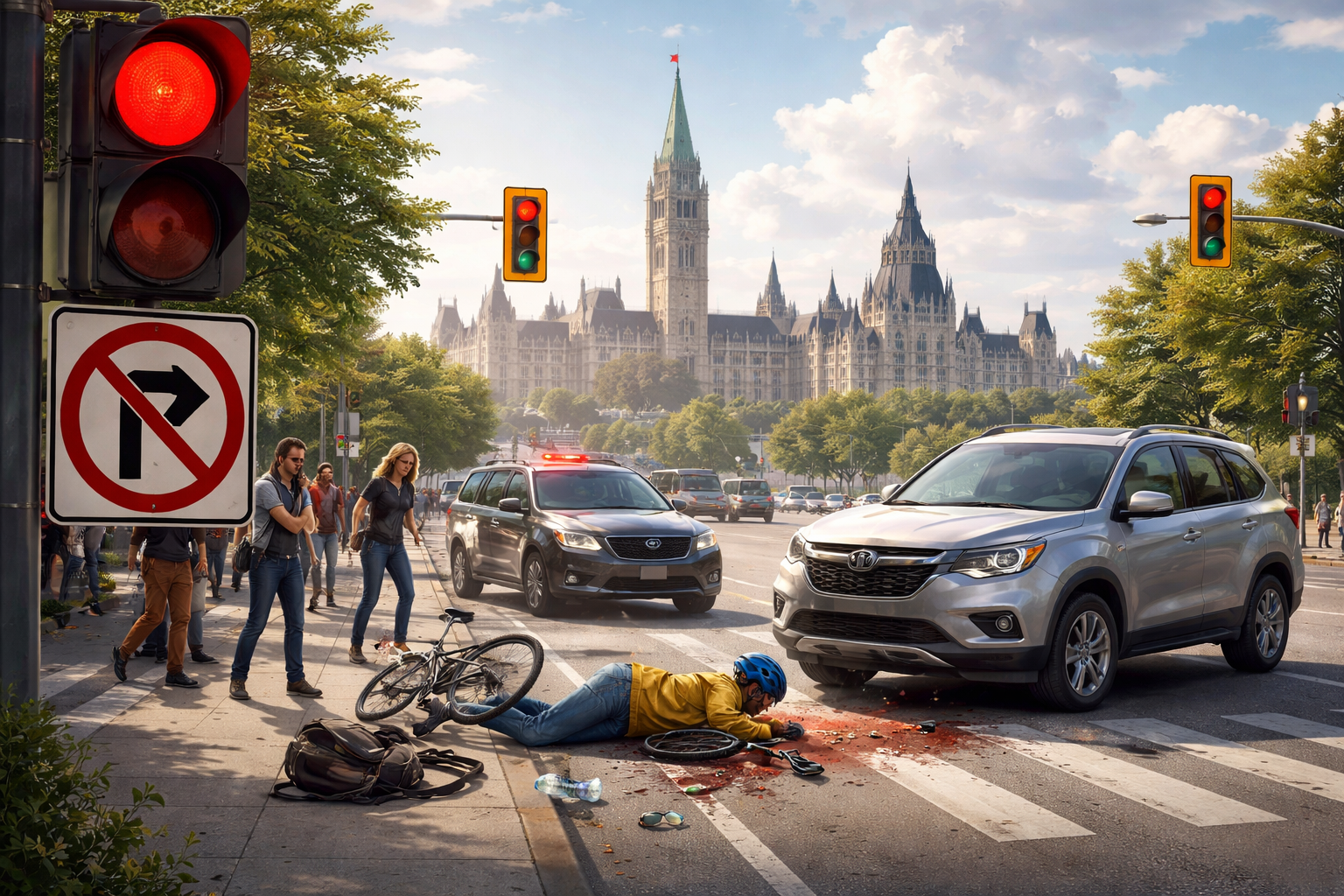

No Right Turn on Red: Solution or a New Problem?
By A. Chupina
Pedestrian safety is truly the highest value in urban space. The death of a 27-year-old woman at the intersection of Elgin Street and Laurier Avenue in Ottawa in July 2025 is not a statistic—it is a tragedy that exposes how vulnerable people are on city streets. It is understandable why, after such events, calls are made for radical measures, including a complete ban on right turns on red in the downtown core.
But urban systems are more complex than they may seem at first glance. Changing familiar traffic rules is always an intervention into an established behavioral pattern shared by thousands of drivers at once. And that is where a serious risk lies: people adapt to new rules gradually, unevenly, and not always predictably.
Ottawa’s specialists point to a paradoxical effect of such a ban. Yes, it removes the conflict between a driver and a pedestrian at one crosswalk. But when the light turns green, drivers begin turning more actively—and that is precisely when danger can arise for pedestrians and cyclists at the adjacent crossing. The problem does not disappear; it shifts.
The situation with bike lanes is especially concerning. A ban may trigger an increase in so-called “right-hook” conflicts: cyclists continue straight while drivers turn right on green, cutting across the cyclists’ path in the driver’s blind spot. This is not theory but a risk identified by city analysts.
Finally, bans work only when they are obeyed. At low-traffic intersections, drivers are more likely to ignore restrictions—and then the violation happens exactly where no one expects danger.
The desire to protect people is admirable. But good intentions require precise tools.