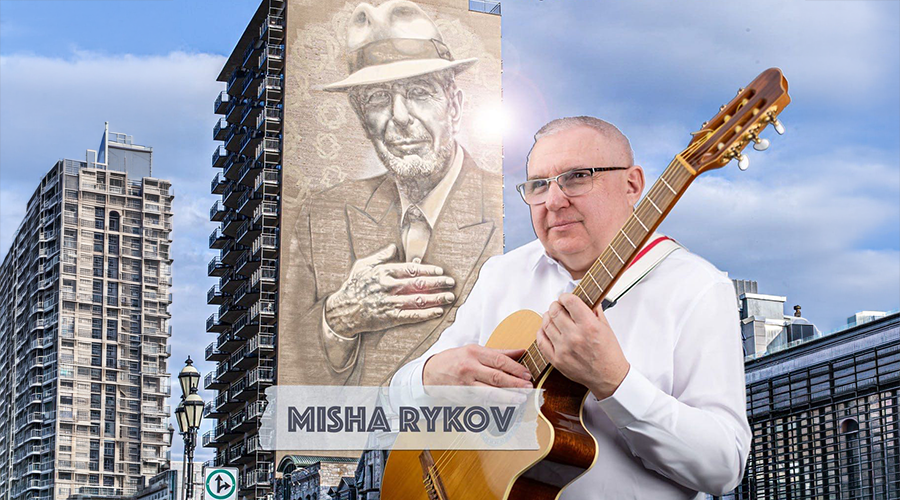

Beauty Sets the Rhythm of the Heart
By Marina Kochetova
We have all heard that beauty will save the world. In a certain sense, that is true. But the phrase “beauty sets the rhythm of the heart,” which I liked so much, does not aspire to a place on a universal pedestal, yet it very accurately conveys the energy of its author — the person this article is about.
In the brief annotation to the poetry almanacs of Ottawa’s creative literary club (TOLK), of which he is a member, he is described as follows: “Computer specialist, musician, translator.” An unusual combination. What lies behind it?
As a child, Misha Rykov loved reading plays. From his school years, he actively participated in various creative activities: reciting on stage, singing to his own accompaniment, and accompanying others. Alongside his regular education, he also studied classical guitar at music school. All of this took place in Minsk, where he was born and raised. As a child, he dreamed of becoming an actor. However, after finishing school, he did not go to theatre school but instead entered the Radio Engineering Institute, enrolling in the then-fashionable Faculty of Automated Control Systems. Even so, while studying engineering, he was far more than an ordinary member of the institute’s folk instruments orchestra during his student years — he was its head monitor, as well as an actor in the student theatre. In addition, he accompanied singers at the student club.
After becoming a certified engineer, he worked in a design bureau in Minsk. It was in those now distant times that the creative duo of M. Rykov (guitar) and Vlada Shametskaya (violin) was born. By the will of fate, the duo later moved to Ottawa and still exists today — the Cantabile duo, popular and in demand among the Russian-speaking public of Canada’s capital.
Misha came to Ottawa from Minsk in 2001. Although he had studied English at school and university in his native city, once immersed in an English-speaking environment, the young man realized that he understood almost nothing, and Canadians could barely understand him either. Three years went into studying English, which took a great deal of strength and time. Yet he did not forget about creativity. Left to his own devices, stubborn Misha kept playing guitar and performing songs by Boris Grebenshchikov, Vladimir Vysotsky, Bulat Okudzhava… singing for his soul, for himself, for friends, enjoying the process and feeling happy despite numerous difficulties.
Time passed… Misha’s English improved by leaps and bounds. His vocabulary eventually became rich enough for him to take the University of Ottawa course “Canadian Poetry. Long Form,” simply for pleasure.
And then he found work in his field, obtaining a position as a systems engineer at the municipality. But can a creative personality really be confined to a five-day workweek from nine to five? Misha keeps a guitar at his workplace. And during lunch breaks, while his Canadian colleagues hurry off to grab a hamburger, their Russian-speaking coworker chooses rehearsal instead of food. It is a kind of relaxation session and also a way of making the most of every opportunity for self-improvement.
His Majesty Chance undoubtedly plays a major role in Misha’s судьба. One day, a friend asked him to translate one of the songs by Canada’s beloved icon Leonard Cohen. The request seemed inappropriate to Misha. Yet the friend would not give up and kept insisting. What won’t one do for a friend? So Misha dared to try. He is a great admirer of Cohen’s work. But it is one thing to enjoy the works of your idol and quite another to translate them. Misha paused to think… And from that point began an intense process of rethinking life’s values. He eagerly absorbed new knowledge, thoughtfully reading the Bible, books on the art of translation, attending linguistics courses and seminars at the University of Ottawa. He began to look at things differently, to see what was happening from a new angle… One only has to begin.
According to Misha, he was almost compelled to take up translation, just as he was compelled to write. But once you try, it becomes impossible to stop. You become dependent on it, like an addict. Constant nourishment is necessary. From nine to five you work in an office at a computer, while all the rest of your time goes into studying the world’s artistic heritage by attending concerts of classical and folk music, exhibitions, and taking part in numerous events in Ottawa’s social life, both as a spectator and as a performer. He is often invited to apartment concerts, and twice he has given solo concerts of Leonard Cohen’s songs — at Ottawa Little Theatre and at the concert hall of Gatineau City Hall. No Belarusian community event can even be imagined without him.
For a long time now, Misha has translated far more than just Leonard Cohen. Working with a living author is twice as interesting. In Russia, in 2019, a book of verbal sonnets by S. Mayne, a Canadian poet and professor of literature at the University of Ottawa, was published in M. Rykov’s translation. Its presentation took place at the main Library and Archives Canada building. More recently, he has developed a passion for translating into Russian the poetry of the renowned Canadian writer and poet Margaret Atwood. And he considers translating the poems of his friend Yuras Shametsky from Belarusian almost his duty. His creative plans are endless. With immense gratitude, M. Rykov speaks of his English teacher Jerry Holland, whom he considers his main mentor. This man teaches language through music. Judging by the fact that his student M. Rykov not only mastered English but rose to the level of a published translator, he teaches very well indeed.
“How can that be?!” some readers may protest. “To translate something serious without being a professional translator?” Do not rush to conclusions, ladies and gentlemen. Better remember how many remarkable actors came out of amateur performance groups, and take off your hat to a creative personality daring to conquer the heights of translation. We sing praises to the courage of the bold!
When performing the mystery of translation, Misha is guided by sensations. He does not translate words and sentences. His translation is neither literal nor merely semantic. It is a translation of feelings. But form requires that these feelings be clothed in certain rhythms, rhymes, and phrases. Only a refined person is capable of such wonders. “The main thing is to be in the subject,” Misha modestly replies when asked about the secrets of his translation, which he generously shares with members of the Canadian interprovincial translators’ club, whose virtual meetings he never misses despite his busy schedule.
Happiness can be different — global or trifling. Sometimes the trifling kind is valued more and means more. We perceive life’s events through how full they are. A chain of ordinary days merges into one grey current of life where everything is faceless. A sum of events is not necessary for happiness. What matters is the unforgettable moment, the fullness of feeling. And Misha, as he himself admits, lives by feelings and has learned to rejoice in small things. In my view, he is a specialist in mobilizing inner reserves. For years now, Misha has not only translated but also periodically writes himself. His poems are not a claim to a poetic “I,” but a living memory of emotional moments in life and a means of self-expression. He does not consider himself a poet:
“I write into a mound of ashes, into dust,
I cannot torment the hearing of poets.”
Ironically calling his thoughts square, flat, and soured, he nevertheless insists: “My heart will never grow tired of beating…”
And God grant that his heart never grows weary of beating. And may beauty continue to set the rhythm for that heart.